
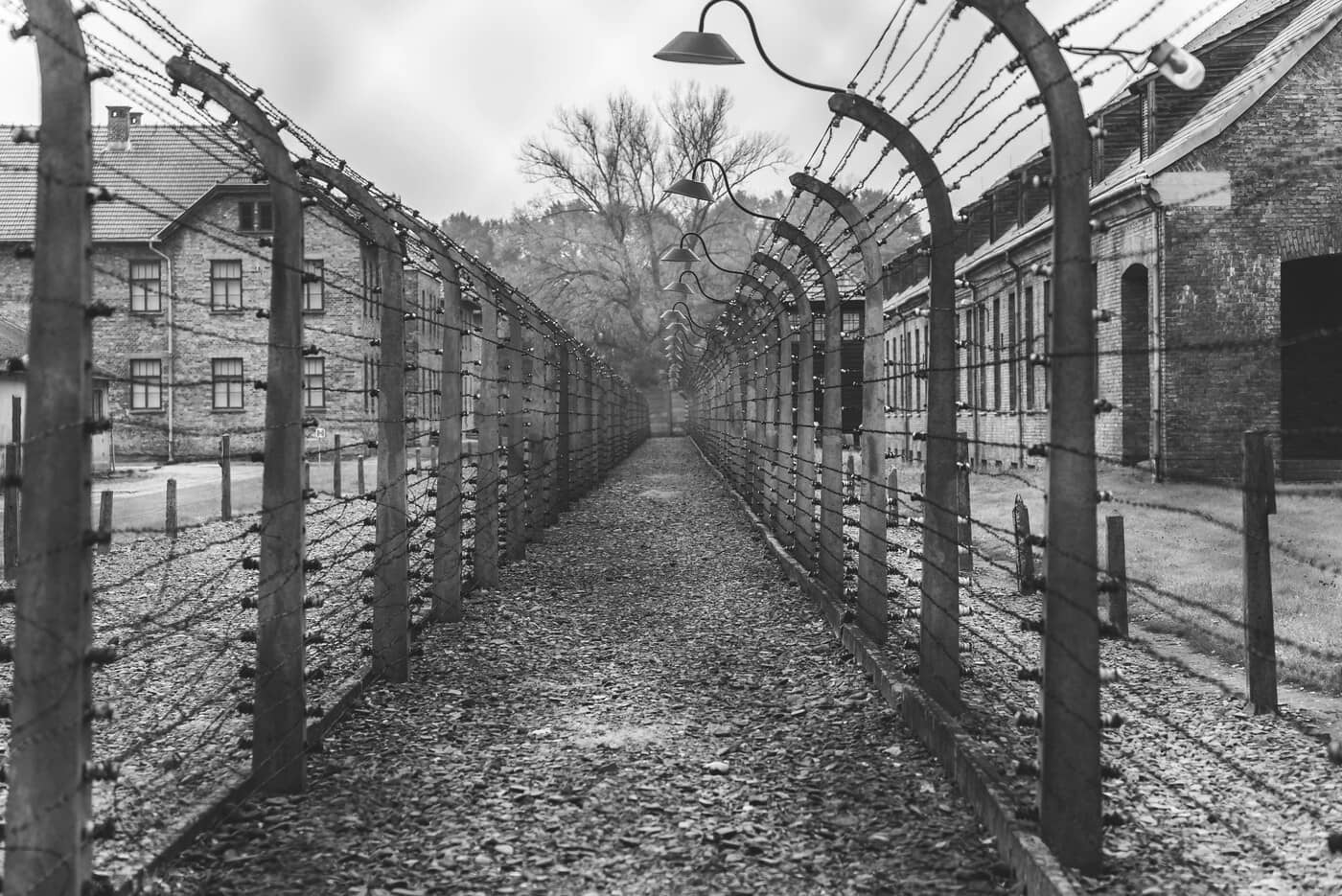
Auschwitz I and Birkenau: What’s the Difference?
Understanding the History and Museum Experience of Auschwitz-Birkenau
For many visitors travelling to Auschwitz from Kraków, one of the first surprises is discovering that Auschwitz is not a single location.
The name “Auschwitz” refers to a vast complex of Nazi German concentration camps, forced labour camps and extermination facilities established during the Second World War in occupied Poland. Today, the Auschwitz-Birkenau Memorial and Museum preserves two main historical sites open to visitors:
- Auschwitz I – the original camp established in 1940, which became the administrative centre and symbolic heart of the Auschwitz complex.
- Auschwitz II–Birkenau – the much larger camp built from 1941, which became the largest site of mass murder within the Nazi extermination system.
Although the two camps are located only about three kilometres (1.9 miles) apart, they were created for different purposes, developed at different stages of the Second World War and today offer distinctly different visitor experiences.
Understanding the differences between Auschwitz I and Birkenau before your visit will help you better appreciate the historical significance of both sites. While Auschwitz I explains how the concentration camp system functioned, Birkenau reveals the unprecedented scale of Nazi Germany’s programme of mass deportation and extermination.
This guide explores the history, purpose and present-day museum experience of both locations, helping first-time visitors understand why they should always be seen together.
Table of Contents
- Auschwitz Was a Camp Complex, Not a Single Camp
- Auschwitz I: The Original Camp
- Auschwitz II–Birkenau: The Largest Part of the Auschwitz Complex
- Common Misconceptions About Auschwitz and Birkenau
- Auschwitz I vs Birkenau: Understanding the Key Differences
- How the Museum Tells Two Different Stories
- Authenticity as a Museum Principle
- Should You Visit Both Auschwitz I and Birkenau?
- How Much Time Should You Allow?
- Frequently Asked Questions
- Guided Tour or Independent Visit?
- Final Thoughts
- Planning Your Visit to Auschwitz?
- Historical References
Auschwitz Was a Camp Complex, Not a Single Camp
One of the most common misconceptions among visitors is that Auschwitz consisted of a single concentration camp. In reality, the name „Auschwitz” refers to an extensive network of camps established and operated by Nazi Germany in occupied Poland between 1940 and 1945.
Over the course of the war, the complex expanded into more than 40 camps and sub-camps, each serving different functions within the Nazi system of imprisonment, forced labour and genocide.
The three principal camps were:
- Auschwitz I – the original concentration camp and administrative headquarters.
- Auschwitz II–Birkenau – the largest section of the complex, where mass deportations, selections and extermination took place.
- Auschwitz III–Monowitz – a forced labour camp established to supply workers for nearby industrial facilities, including the IG Farben chemical plant.
Together, these camps formed one integrated system administered by the SS. Prisoners were frequently transferred between them depending on labour demands, health conditions or administrative decisions.
The evolution of Auschwitz mirrors the radicalisation of Nazi policy during the Second World War. What began as a concentration camp for political prisoners gradually developed into the largest centre of mass murder established by Nazi Germany.
Understanding Auschwitz means understanding that its history did not remain static. The camp changed significantly between 1940 and 1945 as Nazi persecution evolved from imprisonment and forced labour to systematic genocide.
Auschwitz I: The Original Camp
Auschwitz I was established in the spring of 1940 in the town of Oświęcim, which had been annexed by Nazi Germany following the invasion of Poland in September 1939.
The site was selected for practical reasons. It contained former Polish army barracks that could be converted into a prison complex, while the surrounding railway network allowed efficient transport of prisoners and supplies.
The first transport arrived on 14 June 1940, bringing 728 Polish political prisoners from Tarnów prison. At this stage, Auschwitz was intended primarily as a concentration camp for members of the Polish resistance, intellectuals, teachers, clergy and others considered dangerous by the occupation authorities.
Its original purpose was not mass extermination but imprisonment, intimidation and exploitation through forced labour.
The Early Function of Auschwitz I
During its first years of operation, Auschwitz I served several interconnected purposes.
Administrative Headquarters
As the Auschwitz complex expanded, Auschwitz I became its administrative centre. Camp authorities managed prisoner records, logistics, construction projects and the growing network of satellite camps from offices located within the original camp.
Many decisions affecting prisoners held throughout the Auschwitz complex were made here, making Auschwitz I the organisational heart of one of the largest camp systems created by Nazi Germany.
A Place of Imprisonment and Terror
Daily life in Auschwitz I was governed by strict discipline and constant violence. Prisoners endured overcrowded barracks, insufficient food, exhausting labour and severe punishments.
The camp was designed not only to imprison people physically but also to destroy their identity and dignity. Upon arrival, prisoners were stripped of their personal belongings, issued camp uniforms and assigned identification numbers.
Many prisoners were subjected to arbitrary punishment, public executions or prolonged confinement in punishment cells.
Forced Labour
Forced labour formed a central element of the concentration camp system. Prisoners worked on construction projects, road building, agriculture and industrial production under extremely harsh conditions.
Food rations were deliberately inadequate, medical care was minimal and physical exhaustion was widespread. Those who became unable to work were often transferred elsewhere within the camp system or selected for execution.
Block 11: The „Death Block”
Among the most significant buildings preserved at Auschwitz I is Block 11, commonly known as the „Death Block.”
This prison within the prison was used for interrogation, punishment and execution. It contained standing cells, dark cells and starvation cells where prisoners were confined under inhumane conditions.
The courtyard between Blocks 10 and 11 became the site of thousands of executions carried out by firing squad, particularly of Polish political prisoners.
Today, visitors can walk through these areas, which remain among the most powerful reminders of the terror that characterised the concentration camp system.
The First Experiments with Zyklon B
Auschwitz I also occupies an important place in the history of the Holocaust because it was here that the SS conducted the first experimental killings using Zyklon B, a cyanide-based pesticide.
These experiments, carried out in 1941, demonstrated to the Nazi authorities that the poison could be used for mass murder. The experience gained in Auschwitz I later influenced the construction of much larger extermination facilities at Birkenau.
Although a gas chamber and crematorium operated in Auschwitz I, the overwhelming majority of mass killings were later carried out in Auschwitz II–Birkenau.
Auschwitz I Today: The Historical Museum
Today, Auschwitz I functions as the educational centre of the Auschwitz-Birkenau Memorial and Museum.
Unlike many historical museums that rely primarily on replicas or multimedia presentations, Auschwitz I preserves authentic buildings and original artefacts recovered after the liberation of the camp.
Visitors explore former prisoner blocks that now house carefully curated exhibitions explaining the history of the camp and the broader context of the Holocaust.
Among the most moving displays are collections of personal belongings confiscated from deportees, including:
- thousands of shoes
- suitcases bearing victims’ names
- eyeglasses
- kitchen utensils
- prosthetic limbs
- photographs
- letters and official documents
These objects illustrate that the victims of Auschwitz were not anonymous numbers but individuals with families, professions, ambitions and everyday lives that were violently interrupted.
For many visitors, Auschwitz I provides the historical framework needed to understand the wider story of the Auschwitz complex before continuing to Birkenau.
Auschwitz II–Birkenau: The Largest Part of the Auschwitz Complex
Construction of Auschwitz II–Birkenau began in October 1941, approximately three kilometres (1.9 miles) from Auschwitz I. While the original camp occupied former military barracks, Birkenau was designed as a purpose-built complex that could be expanded on an unprecedented scale.
Initially, the camp was intended to hold Soviet prisoners of war. However, as Nazi Germany intensified its campaign of persecution across occupied Europe, Birkenau quickly evolved into something very different. By 1942, it had become the principal site where the Nazi regime carried out the systematic murder of European Jews as part of the policy known as the “Final Solution”.
Unlike Auschwitz I, which developed gradually, Birkenau was planned as an enormous complex capable of receiving mass transports, imprisoning tens of thousands of people and carrying out industrialised murder on a scale unmatched elsewhere in the Nazi concentration camp system.
Why Was Birkenau Built?
The decision to build Birkenau reflected the changing objectives of the Nazi regime. During the first years of the war, concentration camps primarily served to imprison political opponents, exploit forced labour and terrorise occupied populations.
From 1941 onwards, however, Nazi policy became increasingly focused on the systematic destruction of entire communities, particularly Europe’s Jewish population. Existing camps no longer met the logistical demands of these plans.
Birkenau provided several advantages from the perspective of the SS:
- vast areas suitable for continuous expansion
- excellent railway connections linking occupied Europe
- space for hundreds of prisoner barracks
- areas for industrial facilities and forced labour
- the possibility of constructing large crematoria and gas chambers away from the original camp
The result was a camp unlike anything previously built by Nazi Germany. At its greatest extent, Birkenau covered approximately 175 hectares (432 acres) and contained hundreds of structures divided into numerous sectors.
A City Behind Barbed Wire
Visitors often underestimate the sheer size of Birkenau until they arrive. Photographs rarely convey its enormous dimensions.
The camp stretched across an open plain surrounded by electrified fences and watchtowers. Wooden and brick barracks extended towards the horizon, connected by unpaved roads and railway lines.
Historians sometimes describe Birkenau as resembling a grim industrial city rather than a conventional prison. Its infrastructure was designed to process large numbers of people efficiently—from arrival and registration to forced labour or, for many, immediate murder.
The architecture itself illustrates how bureaucracy, engineering and transportation became tools of persecution.
The Railway Gate: A Symbol Recognised Around the World
The entrance building at Birkenau, with its central watchtower and railway line passing beneath it, has become one of the most recognisable images associated with the Holocaust.
Beginning in 1944, trains carrying deportees entered directly into the camp. This eliminated the need to unload prisoners outside the perimeter and allowed selections to take place more quickly and efficiently.
For many victims, the railway tracks marked the beginning of their final moments.
Entire families arrived after journeys lasting several days in overcrowded cattle cars with little access to food, water or sanitation. Many elderly people and children died before the trains even reached Birkenau.
The Selection Process
Immediately after disembarking, deportees were ordered to form lines while SS physicians and officers carried out what they called a selection.
This process determined who would be temporarily spared for forced labour and who would be murdered immediately.
In most cases:
- healthy adults considered capable of work were registered as prisoners
- children
- pregnant women
- elderly people
- many mothers with young children
- people who appeared ill or disabled
were directed towards the gas chambers without being informed of their fate.
Selections often lasted only a few moments. Families were separated permanently within minutes of leaving the train.
One of the defining characteristics of Auschwitz-Birkenau was not only the scale of killing but the speed with which bureaucratic decisions determined life or death.
Gas Chambers and Crematoria
The most significant historical difference between Auschwitz I and Birkenau lies in the presence of large-scale extermination facilities.
Between 1943 and 1944, four crematoria equipped with underground gas chambers operated at Birkenau. Victims were murdered using Zyklon B before their bodies were cremated in adjacent furnaces.
These buildings were designed to increase the efficiency of mass murder while concealing the process from newly arrived deportees.
During the summer of 1944, when hundreds of thousands of Hungarian Jews were deported to Auschwitz, the crematoria operated at maximum capacity. Temporary open-air burning pits were also used when the number of victims exceeded the capacity of the cremation ovens.
As Soviet forces approached in January 1945, the SS destroyed much of the extermination infrastructure in an attempt to eliminate evidence of the crimes committed there.
Today, visitors see the ruins of Crematoria II, III, IV and V rather than reconstructed buildings. The decision to preserve the ruins reflects the museum’s commitment to authenticity rather than reconstruction.
Life Inside Birkenau
Although Birkenau is most closely associated with mass extermination, it was also a concentration and forced labour camp where tens of thousands of prisoners lived under appalling conditions.
Many barracks were originally designed as horse stables before being converted for human use. Others were hastily constructed from wood using simple materials never intended for long-term habitation.
Prisoners endured:
- extreme overcrowding
- insufficient heating during harsh Polish winters
- poor sanitation
- limited access to clean drinking water
- chronic malnutrition
- infectious diseases such as typhus and dysentery
Even those who survived the initial selection faced constant exhaustion, disease and violence. Mortality remained extremely high due to starvation, forced labour, illness and executions.
Birkenau Today: A Landscape of Memory
Visitors are often struck by the profound contrast between Auschwitz I and Birkenau.
At Auschwitz I, history is largely interpreted through exhibitions housed inside preserved buildings. At Birkenau, history is communicated primarily through the landscape itself.
Large sections of the camp remain open fields where barracks once stood. Only the brick chimneys survive in many places, marking the locations of buildings that disappeared after the war.
This apparent emptiness is not the absence of history—it is part of the historical evidence.
The vast open spaces illustrate both the original scale of the camp and the deliberate destruction carried out by the SS before liberation. Rather than reconstructing what was lost, the Memorial has chosen to preserve these remains in their authentic state, allowing visitors to confront the physical traces of history.
Common Misconceptions About Auschwitz and Birkenau
„Auschwitz and Birkenau were two separate camps.”
Not exactly. Auschwitz II–Birkenau was one part of the larger Auschwitz camp complex administered by the SS. Together with Auschwitz I and Auschwitz III–Monowitz, it formed an integrated system of concentration, forced labour and extermination.
„Only Jews were imprisoned at Auschwitz.”
Although Jews constituted the largest group of victims, Auschwitz also imprisoned Poles, Roma and Sinti, Soviet prisoners of war and prisoners of many other nationalities.
„Everyone arriving at Birkenau was immediately sent to the gas chambers.”
No. Upon arrival, prisoners underwent a selection process. Those considered capable of forced labour were registered, while many children, elderly people and others were murdered shortly after arrival.
„Auschwitz I was only a museum.”
Today Auschwitz I contains museum exhibitions, but every building is an authentic historical structure where prisoners once lived, worked or were imprisoned.
„Birkenau is empty because nothing remains.”
The open landscape is itself part of the historical evidence. Many structures were deliberately destroyed by the SS before liberation, while others deteriorated over time. The Memorial preserves these remains rather than reconstructing them.
Auschwitz I vs Birkenau: Understanding the Key Differences
Although Auschwitz I and Auschwitz II–Birkenau formed one integrated camp complex under a single SS administration, they fulfilled different functions during the Second World War. Today, these differences also shape how the Auschwitz-Birkenau Memorial and Museum presents history to visitors.
Rather than asking which site is „more important,” it is more accurate to recognise that each explains a different dimension of Nazi persecution. Auschwitz I reveals how the concentration camp system operated on a daily basis. Birkenau demonstrates the scale on which that system evolved into industrialised genocide.
Historical Comparison
| CATEGORY | AUSCHWITZ I | AUSCHWITZ II- BIRKENAU |
|---|---|---|
| Established | 1940 | 1941 |
| Original purpose | Concentration camp for Polish political prisoners | Expansion camp, later the principal extermination site |
| Main historical role | Administration, imprisonment, punishment and forced labour | Mass deportation, selection, forced labour and extermination |
| Area | Approx. 20 hectares | Approx. 175 hectares |
| Architecture | Brick military barracks | Purpose-built wooden and brick barracks |
| Present-day experience | Museum exhibitions inside preserved buildings | Large historical landscape with original remains |
| Most recognisable landmark | „Arbeit Macht Frei” gate | Railway gate and railway tracks |
How the Museum Tells Two Different Stories
One of the most remarkable aspects of the Auschwitz-Birkenau Memorial is that it does not present history in the same way at both locations. Instead, each site preserves its own historical character and allows visitors to understand different aspects of the camp system.
Auschwitz I: History Through Objects
Inside Auschwitz I, visitors encounter history primarily through carefully preserved artefacts and documentary evidence.
Museum exhibitions contain thousands of authentic objects recovered after liberation, including shoes, suitcases, eyeglasses, kitchen utensils, clothing, photographs and official documents. These collections transform statistics into individual human stories.
A suitcase labelled with a child’s name or a family photograph recovered from camp warehouses reminds visitors that every victim had a life before deportation. The exhibitions therefore focus on identity, biography and personal experience.
This approach allows visitors to understand the human dimension of Nazi persecution while learning how the concentration camp system functioned through administrative documents, prisoner records and historical photographs.
Birkenau: History Through Space
Birkenau communicates history differently. Here, the landscape itself becomes the exhibition.
Rather than moving through museum galleries, visitors walk along the same railway tracks where deportation trains arrived, pass rows of barracks where prisoners lived and stand beside the ruins of crematoria destroyed by the SS in January 1945.
The physical scale of the camp is impossible to reproduce through photographs or written descriptions alone. Walking across Birkenau helps visitors understand the immense logistical organisation behind the Nazi system of deportation, imprisonment and mass murder.
Silence also plays an important role in the visitor experience. Large areas remain undeveloped, allowing the landscape itself to convey the enormity of the crimes committed there.
At Auschwitz I, visitors primarily read history. At Birkenau, they walk through it.
Authenticity as a Museum Principle
Unlike many historical museums, the Auschwitz-Birkenau Memorial does not attempt to recreate or dramatise the past through extensive reconstructions or multimedia installations. Instead, its guiding principle is the preservation of authenticity.
Original buildings, roads, fences, guard towers, prisoner blocks and ruins are carefully conserved using internationally recognised conservation methods. Where structures no longer survive, the museum generally avoids rebuilding them unless there is a compelling conservation reason.
This philosophy reflects the belief that the original remains possess historical value that no reconstruction can replace.
Visitors therefore encounter Auschwitz not as a reconstructed historical attraction but as an authentic place where the events of the Holocaust occurred.
Should You Visit Both Auschwitz I and Birkenau?
The simple answer is yes.
Although some visitors initially consider spending their entire visit at Auschwitz I because it contains the museum exhibitions, doing so provides only part of the historical picture.
Likewise, visiting only Birkenau without first understanding the history presented in Auschwitz I may leave many questions unanswered.
The two sites complement one another.
- Auschwitz I explains how the concentration camp system operated, who the prisoners were and how Nazi administration functioned.
- Birkenau demonstrates the enormous physical scale of deportation, forced labour and extermination.
Together, they provide the most complete understanding of the Auschwitz camp complex and the history it represents.
How Much Time Should You Allow?
A full visit to both parts of the memorial usually takes between 3.5 and 4 hours, not including travel from Kraków.
Most organised tours include transportation between Auschwitz I and Birkenau, which takes approximately ten minutes by shuttle bus or coach.
Visitors exploring independently should also allow time to move between the two locations and to reflect on the exhibitions and memorial spaces.
Frequently Asked Questions
Is Auschwitz I the same as Birkenau?
No. Auschwitz I and Auschwitz II–Birkenau were two different parts of the same camp complex. Auschwitz I served as the administrative and concentration camp, while Birkenau became the largest site of mass extermination.
Which site is larger?
Birkenau is significantly larger. It covers approximately 175 hectares, compared with around 20 hectares for Auschwitz I.
Why are there more exhibitions at Auschwitz I?
Many original brick buildings survived the war, making Auschwitz I suitable for permanent museum exhibitions. Birkenau has been preserved primarily as an authentic historical landscape rather than an exhibition space.
Why are many buildings missing at Birkenau?
Before retreating in January 1945, the SS destroyed gas chambers, crematoria and many documents in an attempt to conceal evidence of Nazi crimes. Other wooden barracks deteriorated after the war. The museum has largely preserved these remains rather than reconstructing them.
Can you visit only Birkenau?
Yes, but most historians and museum educators recommend visiting both sites because they explain different aspects of Auschwitz’s history.
Which site is more emotional to visit?
Visitors often describe the experiences differently. Auschwitz I is emotionally powerful because of its exhibitions and personal belongings of victims. Birkenau affects many people through its vast scale, open landscape and the preserved ruins of the crematoria. Both sites offer distinct but complementary experiences.
Guided Tour or Independent Visit?
Because Auschwitz I and Birkenau represent complex historical events, many visitors choose a guided tour.
A professional guide can explain:
- why each site was created
- how the camp system developed
- the meaning of preserved buildings
- the stories behind specific exhibitions
Without historical context, some elements of the memorial may be difficult to understand.
For first-time visitors, a guided tour often provides a clearer understanding of how Auschwitz I and Birkenau were connected within the wider Nazi system.
Final Thoughts
Although separated by only a few kilometres, Auschwitz I and Auschwitz II–Birkenau tell different chapters of the same history.
Auschwitz I helps visitors understand how the Nazi concentration camp system functioned through original buildings, exhibitions and documentary evidence. Birkenau reveals the immense scale of deportation, forced labour and systematic extermination carried out during the Holocaust.
Together, they form one of the world’s most important memorial sites—a place dedicated not only to preserving historical evidence but also to honouring the victims and educating future generations.
For visitors travelling from Kraków, understanding the difference between Auschwitz I and Birkenau before arriving allows for a deeper and more respectful experience. These are not simply museum exhibitions—they are authentic historical places that preserve evidence of what happened and remind future generations why remembrance matters.
Planning Your Visit to Auschwitz?
Our guided tours from Krakow include both Auschwitz I and Auschwitz II–Birkenau, giving you the opportunity to explore the complete memorial with a licensed English-speaking guide who provides historical context throughout the visit.
Historical References
The historical information presented in this article is based on research and publications from internationally recognised institutions dedicated to preserving the history of the Holocaust and the Auschwitz-Birkenau Memorial.
- Auschwitz-Birkenau Memorial and Museum. Auschwitz.org – History of the Camp, Victims, Deportations, Gas Chambers, Preservation of the Memorial. Available at: https://www.auschwitz.org/
- United States Holocaust Memorial Museum. Holocaust Encyclopedia – Auschwitz. https://encyclopedia.ushmm.org/
- Yad Vashem – The World Holocaust Remembrance Center. The Holocaust Resource Center. https://www.yadvashem.org/
- UNESCO World Heritage Centre. Auschwitz Birkenau German Nazi Concentration and Extermination Camp (1940–1945). https://whc.unesco.org/
- Danuta Czech. Auschwitz Chronicle 1939–1945. Henry Holt & Company.
- Franciszek Piper. Auschwitz: How Many Perished. Auschwitz-Birkenau State Museum.


