The History of Auschwitz: A Beginner’s Guide
Every year, millions of people from around the world travel to southern Poland to visit Auschwitz-Birkenau Memorial and Museum. For many, it is one of the most emotional and educational experiences of their journey through Europe. Unlike traditional museums, Auschwitz is an authentic historical site where more than one million people lost their lives during the Second World War.
Understanding the history of Auschwitz before visiting helps place what you will see into its proper historical context. The preserved barracks, railway tracks, personal belongings, photographs and memorials tell stories that extend far beyond the physical remains of the camp itself. They reveal how one of history’s greatest crimes became possible and why remembering it continues to matter today.
This beginner’s guide explains how Auschwitz was established, how it evolved into the largest Nazi German concentration and extermination camp, who its victims were, and why it remains one of the world’s most significant memorial sites.
Table of Contents
- What Was Auschwitz?
- Why Was Auschwitz Built?
- Understanding the Auschwitz Camp Complex
- Deportations from Across Europe
- Who Were the Victims?
- The Selection Process
- Forced Labour
- Daily Life Inside Auschwitz
- The Liberation of Auschwitz
- Auschwitz After the War
- UNESCO World Heritage Site
- Why Auschwitz Still Matters Today
- Preparing for Your Visit
- Frequently Asked Questions
- Final Thoughts
- Planning to Visit Auschwitz from Krakow?
- References
What Was Auschwitz?
Auschwitz was the largest complex of concentration and extermination camps established by Nazi Germany during the Second World War. Located near the Polish town of Oświęcim—approximately 70 kilometres (43 miles) west of Kraków—the camp operated between 1940 and January 1945.
The Auschwitz camp complex operated from June 1940 until January 1945. During this period, it expanded into the largest concentration and extermination camp established by Nazi Germany. According to research conducted by the Auschwitz-Birkenau Memorial and Museum, at least 1.1 million people were murdered there, approximately one million of whom were Jews. The remaining victims included Poles, Roma and Sinti, Soviet prisoners of war and prisoners of other nationalities.
Sources: Auschwitz-Birkenau Memorial and Museum, The Number of Victims; United States Holocaust Memorial Museum, Auschwitz.
Today, the name “Auschwitz” has become synonymous with the Holocaust. Yet many first-time visitors are surprised to learn that Auschwitz was not originally created as an extermination camp. When it opened in June 1940, its primary purpose was to imprison Polish political prisoners following Germany’s invasion and occupation of Poland.
As Nazi policies became increasingly radical, particularly after the decision to implement the so-called Final Solution to the Jewish Question, Auschwitz expanded dramatically. It eventually became the largest centre for the systematic murder of European Jews while continuing to imprison and exploit countless victims through forced labour.
According to research conducted by the Auschwitz-Birkenau State Museum, historians estimate that at least 1.1 million people were murdered in the Auschwitz camp complex. Approximately one million of the victims were Jews deported from nearly every occupied country in Europe.
Other victims included:
- Polish political prisoners
- Roma and Sinti
- Soviet prisoners of war
- Prisoners from many European countries
- Individuals persecuted because of their ethnicity, religion, political beliefs or other reasons under Nazi racial ideology
The camp has become one of the most recognizable symbols of the Holocaust and serves as a reminder of the consequences of hatred, racism, antisemitism and totalitarian rule.
Why Was Auschwitz Built?
To understand Auschwitz, it is important to place it within the wider context of Nazi occupation policy. After Germany invaded Poland on 1 September 1939, the occupying authorities established prisons, ghettos and concentration camps across the country to suppress resistance and control the population.
In April 1940, Heinrich Himmler, Reichsführer-SS, approved the creation of a new concentration camp in Oświęcim. Several practical factors influenced the decision:
- Existing Polish military barracks could be adapted quickly
- The town had excellent railway connections with occupied Europe
- The surrounding area offered space for future expansion
- Nearby industrial zones created opportunities for forced labour
On 27 April 1940, Heinrich Himmler ordered the establishment of a concentration camp in Oświęcim. The first transport of 728 Polish political prisoners arrived on 14 June 1940 from the prison in Tarnów. During its first months, Auschwitz primarily served as a concentration camp for members of the Polish resistance, intellectuals and others considered enemies of the occupation authorities.
Sources: Auschwitz-Birkenau Memorial and Museum, The Beginnings of Auschwitz; Danuta Czech, Auschwitz Chronicle 1939–1945.
The transformation occurred gradually. Throughout 1941 and especially after the Wannsee Conference in January 1942, Auschwitz became central to the implementation of Nazi plans for the extermination of Europe’s Jewish population. New crematoria, gas chambers and railway infrastructure allowed the camp to process transports arriving daily from across occupied Europe.
Understanding the Auschwitz Camp Complex
One of the most common misconceptions is that Auschwitz consisted of a single camp. In reality, it was an enormous complex made up of more than 40 camps and sub-camps, each serving different purposes.
The three principal camps were Auschwitz I, Auschwitz II-Birkenau and Auschwitz III-Monowitz. Together they formed the administrative, industrial and extermination centre of the Auschwitz complex.
Auschwitz I
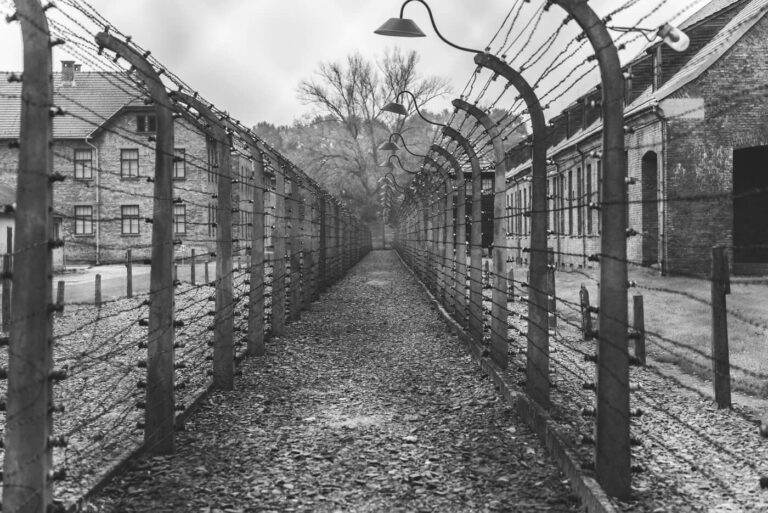
Established in 1940, Auschwitz I served as the administrative headquarters of the entire camp system. It occupied former Polish army barracks that were converted into prison blocks surrounded by electrified barbed-wire fences and guard towers.
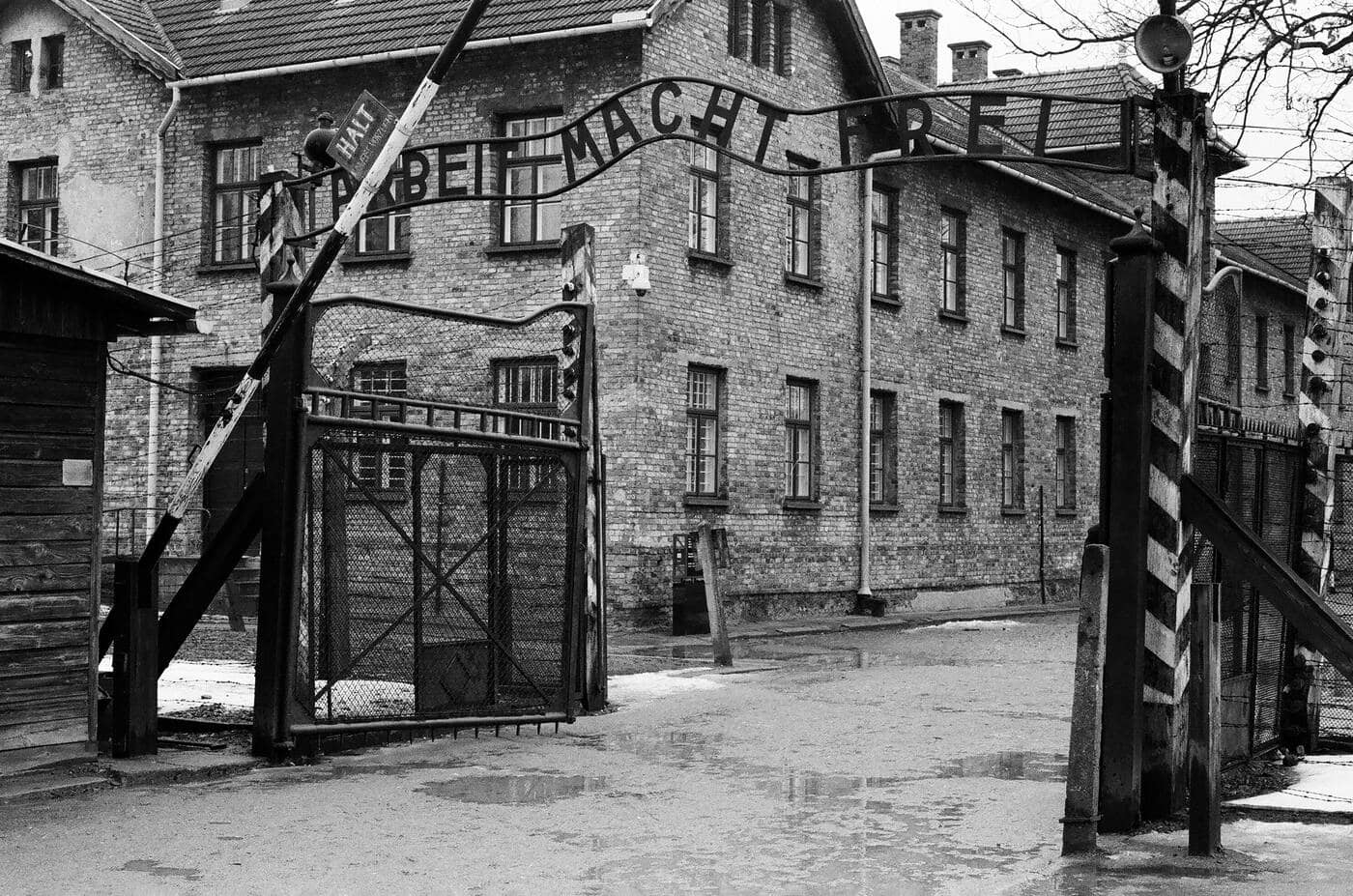
This is the section visited first by most tourists today. Above the entrance gate hangs the infamous inscription “Arbeit Macht Frei” (“Work Sets You Free”), a slogan cynically intended to deceive prisoners and reinforce Nazi propaganda.
Many original brick buildings remain intact and now house permanent museum exhibitions presenting authentic historical artefacts, documents and testimonies. Among the most moving displays are collections of:
- children’s shoes
- eyeglasses
- suitcases bearing prisoners’ names
- kitchen utensils
- prosthetic limbs
- hair cut from victims before their murder
These personal belongings remind visitors that every statistic represents an individual human life.
Auschwitz II – Birkenau
Construction of Auschwitz II–Birkenau began in October 1941, approximately three kilometres from Auschwitz I. Designed on a much larger scale, Birkenau eventually covered nearly 175 hectares (432 acres) and became the largest section of the Auschwitz complex.
Originally intended as a camp for Soviet prisoners of war, Birkenau quickly became the principal site of the Nazis’ mass extermination programme. Beginning in 1942, deportation trains carrying Jews from across occupied Europe arrived directly at the camp, making Birkenau one of the central locations of the Holocaust.
Beginning in spring 1942, Birkenau became the principal site for implementing the Nazi policy known as the “Final Solution.” Four large crematoria equipped with gas chambers were constructed between 1943 and 1944. Most victims were murdered using Zyklon B, a cyanide-based pesticide that had previously been employed for disinfection purposes.
Sources: Auschwitz-Birkenau Memorial and Museum, Crematoria and Gas Chambers; United States Holocaust Memorial Museum, Final Solution.
The railway spur built inside the camp allowed deportation trains to unload thousands of people each day. Upon arrival, prisoners underwent what the SS referred to as a “selection.” Within only a few minutes, doctors and SS officers decided who would be temporarily spared for forced labour and who would be murdered immediately.
Most children, elderly people, pregnant women, mothers with young children and individuals considered unable to work were sent directly to the gas chambers without being registered as prisoners.
Those selected for labour were stripped of their possessions, disinfected, assigned prisoner numbers and forced into overcrowded barracks where they faced starvation, disease and exhausting physical labour.
Today, visitors can still see:
- the original railway tracks entering Birkenau
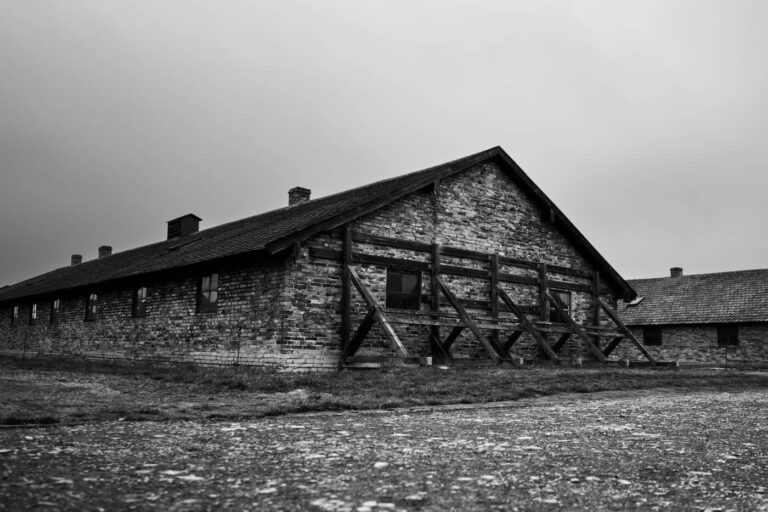
- the remains of prisoner barracks
- guard towers and barbed-wire fences
- the ruins of Crematoria II, III, IV and V
- the International Monument to the Victims of Fascism
Auschwitz III – Monowitz
Auschwitz III, commonly known as Monowitz, was established in 1942 to provide forced labour for nearby industrial facilities, most notably the enormous synthetic rubber and fuel plant operated by the German chemical corporation IG Farben.
Unlike Birkenau, Monowitz functioned primarily as a labour camp. Prisoners worked under brutal conditions, often for twelve hours or more each day with little food, inadequate clothing and almost no medical care.
Many prisoners died from exhaustion, starvation or disease. Others who became too weak to work were transferred back to Birkenau, where many were murdered in the gas chambers.
The existence of Monowitz illustrates an important aspect of Auschwitz that is sometimes overlooked: the camp system served not only ideological goals but also economic ones. German industry benefited directly from the exploitation of concentration camp prisoners as a source of forced labour.
Deportations from Across Europe
Although Auschwitz was located in occupied Poland, the overwhelming majority of Jewish victims were deported from other European countries. The camp became an international destination within the Nazi deportation network, connected by thousands of kilometres of railway lines.
Between 1942 and 1944, trains arrived almost daily carrying Jews from:
- Hungary
- France
- The Netherlands
- Belgium
- Germany
- Austria
- Italy
- Greece
- Czechoslovakia
- Yugoslavia
- Norway
- Luxembourg
- and many other occupied territories
More than 1.3 million people were deported to Auschwitz during the camp’s existence. The largest single deportation operation took place between May and July 1944, when approximately 430,000 Hungarian Jews were transported to Birkenau. Historians estimate that around three-quarters were murdered shortly after arrival.
Sources: Auschwitz-Birkenau Memorial and Museum, Hungarian Jews; Yad Vashem, The Deportation of Hungarian Jewry.
The efficiency with which these deportations were organised demonstrates how genocide depended not only on ideology but also on bureaucracy, transportation systems and cooperation between numerous state institutions under Nazi rule.
Who Were the Victims?
While Auschwitz is most closely associated with the Holocaust, the camp imprisoned people from many different backgrounds. Understanding this diversity is essential for appreciating the full history of the site.
The largest victim group consisted of European Jews deported as part of Nazi Germany’s policy of systematic extermination. However, thousands of others were imprisoned because of political resistance, ethnicity, nationality or perceived opposition to the Nazi regime.
Victims included:
- Jewish men, women and children from across Europe
- Polish political prisoners and members of the resistance
- Roma and Sinti families
- Soviet prisoners of war
- Czech, French, Dutch, Belgian and Yugoslav prisoners
- clergy, intellectuals and educators
- people persecuted because of their political beliefs or nationality
Many prisoners arriving at Auschwitz were registered, photographed and assigned identification numbers.
Unlike most Nazi concentration camps, Auschwitz introduced the systematic tattooing of prisoner identification numbers. Initially, numbers were stamped onto prisoners’ chests using a metal stamp before the practice evolved into tattooing on the left forearm. Not every prisoner received a tattoo—many victims sent directly to the gas chambers were never registered.
Source: Auschwitz-Birkenau Memorial and Museum, Prisoner Identification.
However, it is important to note that many victims—particularly Jewish deportees sent directly to the gas chambers—were never registered at all. Their names often survive only through transport records, survivor testimonies and historical research.
The Selection Process
One of the defining features of Auschwitz-Birkenau was the process known as selection. Immediately after deportation trains arrived, SS physicians and officers divided prisoners into two groups.
The majority of healthy adults considered capable of work were temporarily admitted to the camp. Others—including most children, elderly people, pregnant women and those judged physically weak—were sent directly to the gas chambers.
Selections also continued inside the camp. Prisoners who became ill, severely malnourished or unable to work were often selected for execution or transferred to Birkenau for murder.
These decisions were made within moments and without any form of legal process. Families were frequently separated forever immediately after stepping off the train.
Forced Labour
Forced labour formed an essential component of the Auschwitz camp system. Prisoners worked on construction projects, agricultural estates, road building, mining operations and in factories supplying Germany’s wartime economy.
Working conditions were deliberately inhumane. Prisoners received starvation-level food rations while performing physically exhausting labour regardless of weather conditions. Injuries, illness and exhaustion were commonplace.
Numerous German companies—including IG Farben, Krupp and Siemens—used concentration camp labour during the war. Historians continue to study the extent to which private industry benefited from the exploitation of prisoners held within the Auschwitz complex.
Daily Life Inside Auschwitz
Life in Auschwitz was organised to strip prisoners of their identity, dignity and hope. Upon arrival, personal possessions were confiscated, heads were shaved and prisoners were issued striped uniforms bearing coloured triangles identifying their prisoner category.
A typical day began before dawn with a roll call (Appell) that could last for hours regardless of rain, snow or freezing temperatures. Prisoners then marched to work details, often covering long distances on foot before beginning physically demanding labour.
Food consisted of watery soup, a small piece of bread and limited additional rations that provided far fewer calories than required for survival. Combined with hard labour and poor sanitation, chronic malnutrition became one of the leading causes of death.
Disease spread rapidly through overcrowded barracks lacking heating, adequate washing facilities and proper medical treatment. Typhus, dysentery and tuberculosis claimed thousands of lives.
Punishments were severe. Prisoners could be beaten, subjected to standing cells, starvation or public execution for even minor infractions or alleged acts of resistance.
Despite these conditions, many prisoners attempted to preserve their humanity by helping one another, sharing food, documenting events in secret or participating in acts of resistance whenever possible.
The Liberation of Auschwitz
When Soviet forces liberated Auschwitz on 27 January 1945, they found approximately 7,000 surviving prisoners. They also discovered warehouses containing around 370,000 men’s suits, more than 800,000 women’s garments and over 43,000 pairs of shoes—evidence of the immense scale of the crimes committed there.
Sources: United States Holocaust Memorial Museum; Auschwitz-Birkenau Memorial and Museum.
By late 1944, the course of the Second World War had shifted decisively against Nazi Germany. As the Soviet Army advanced westward, the SS began dismantling parts of the Auschwitz complex in an attempt to destroy evidence of the crimes committed there. Documents were burned, buildings were demolished, and several gas chambers and crematoria at Birkenau were blown up.
In January 1945, approximately 56,000 prisoners were forced to leave Auschwitz on foot in what became known as the Death Marches. They were driven westward in freezing winter conditions with little food or shelter. Thousands died from exhaustion, starvation, exposure, or were shot by SS guards when they could no longer continue.
On 27 January 1945, soldiers of the Soviet Red Army entered the Auschwitz complex. Around 7,000 prisoners—many of them gravely ill or too weak to march—remained in the camps. They were liberated after nearly five years of the camp’s operation.
The Soviet soldiers also discovered warehouses filled with belongings confiscated from deportees, including hundreds of thousands of items such as shoes, suitcases, eyeglasses, clothing, kitchen utensils and personal documents. These objects provided overwhelming physical evidence of the scale of Nazi crimes.
Today, 27 January is observed internationally as International Holocaust Remembrance Day, established by the United Nations in 2005 to commemorate the victims of the Holocaust and promote education about one of history’s darkest chapters.
Auschwitz After the War
Following the end of the Second World War, former prisoners, historians and the Polish authorities recognised the importance of preserving Auschwitz as authentic evidence of Nazi crimes.
In 1947, the Polish Parliament established the Auschwitz-Birkenau State Museum. Its mission was to preserve the original remains of the camp, conduct historical research and educate future generations about the Holocaust and the Second World War.
Conservation at Auschwitz presents unique challenges. Many original buildings were constructed as temporary structures and continue to deteriorate due to weather conditions and the passage of time. Specialists from around the world work continuously to preserve barracks, documents, personal belongings, fences and other historical artefacts while maintaining the site’s authenticity.
Today, the museum houses one of the world’s most important collections relating to the Holocaust, including:
- original prisoner records and administrative documents
- photographs taken during the camp’s operation
- survivor testimonies
- thousands of personal belongings recovered after liberation
- architectural remains of the camp complex
UNESCO World Heritage Site
UNESCO added Auschwitz-Birkenau to the World Heritage List in 1979 under the official name “Auschwitz Birkenau German Nazi Concentration and Extermination Camp (1940–1945).” The designation recognises the site’s universal historical significance as evidence of the Holocaust and one of the greatest crimes against humanity.
Source: UNESCO World Heritage Centre.
It remains one of the very few World Heritage Sites included primarily because of its historical significance rather than its architectural or natural value.
UNESCO recognises Auschwitz as a place that preserves the authentic evidence of genocide and serves as a permanent reminder of the consequences of intolerance, racism and antisemitism.
Each year, visitors from more than 150 countries come to Auschwitz-Birkenau to learn about the Holocaust, honour the victims and reflect on the importance of protecting human rights.
Why Auschwitz Still Matters Today
More than eighty years after its liberation, Auschwitz continues to hold profound historical, educational and moral significance.
For historians, it provides one of the most thoroughly documented examples of how the Nazi concentration camp system functioned. Extensive archival records, survivor testimonies, archaeological evidence and preserved buildings allow researchers to reconstruct events with remarkable accuracy.
For educators, Auschwitz offers an opportunity to teach not only about the Holocaust but also about the dangers of prejudice, authoritarianism, propaganda and the systematic denial of human rights.
For visitors, the memorial represents far more than a historical attraction. It is a place of remembrance where every preserved building, photograph and personal object tells the story of an individual life affected by Nazi persecution.
Understanding the history of Auschwitz also helps counter misinformation and Holocaust denial by presenting documented historical evidence preserved at the original site.
Preparing for Your Visit
Many visitors choose to learn about Auschwitz before arriving because understanding the historical background makes the visit significantly more meaningful.
If you are planning a trip from Kraków, consider allowing enough time to visit both Auschwitz I and Auschwitz II–Birkenau. Together, the two sites provide a more complete understanding of the history and scale of the camp complex.
A guided tour is often recommended for first-time visitors. Professional educators and licensed guides explain the historical context behind the buildings, exhibitions and memorials, helping visitors better understand what they are seeing while answering questions throughout the visit.
Because Auschwitz is a place of remembrance, visitors are encouraged to behave respectfully throughout their visit. Appropriate clothing, quiet conversation and sensitivity toward other visitors contribute to maintaining the dignity of the memorial.
Frequently Asked Questions
Why was Auschwitz built?
Auschwitz was originally established in 1940 as a concentration camp for Polish political prisoners. It later expanded into the largest Nazi German concentration and extermination camp during the Holocaust.
How many people died at Auschwitz?
Historians estimate that at least 1.1 million people were murdered at Auschwitz. Around one million were Jews, while the remaining victims included Poles, Roma, Soviet prisoners of war and prisoners of other nationalities.
What is the difference between Auschwitz and Birkenau?
Auschwitz I was the original camp and administrative centre. Auschwitz II–Birkenau was much larger and became the principal site of mass extermination during the Holocaust.
Can you visit Auschwitz without knowing its history?
Yes, but learning about the history beforehand greatly enhances the experience and helps visitors better understand the significance of the preserved buildings, exhibitions and memorials.
How much time should you spend at Auschwitz?
Most visitors spend between 3.5 and 4 hours exploring Auschwitz I and Birkenau. Guided tours generally include transportation between the two sites.
Is Auschwitz suitable for children?
Due to the difficult subject matter, the museum generally recommends that visitors be at least 14 years old, although the final decision rests with parents or guardians.
Why is Auschwitz preserved today?
The memorial exists to honour the victims, preserve authentic historical evidence and educate future generations about the Holocaust and the consequences of hatred, discrimination and genocide.
Final Thoughts
Auschwitz-Birkenau stands today as one of the most important memorial sites in the world. Its preserved buildings, exhibitions and personal artefacts provide powerful evidence of the crimes committed during the Holocaust while reminding future generations of the importance of defending human dignity and human rights.
Whether you are planning an organised tour from Kraków or arranging your own visit, taking time to understand the history of Auschwitz beforehand will help you approach the memorial with greater knowledge, perspective and respect.
History cannot be changed, but it can be remembered, studied and passed on. Visiting Auschwitz is an opportunity to honour the victims by ensuring that their stories continue to be told.
Planning to Visit Auschwitz from Krakow?
If you’re planning your visit, explore our guided Auschwitz tours from Krakow. Our experienced, English-speaking guides provide historical context throughout the tour, helping you better understand one of the world’s most important memorial sites.
References
- Auschwitz-Birkenau Memorial and Museum. www.auschwitz.org
- United States Holocaust Memorial Museum. Holocaust Encyclopedia – Auschwitz.
- Yad Vashem. The World Holocaust Remembrance Center.
- UNESCO World Heritage Centre. Auschwitz Birkenau German Nazi Concentration and Extermination Camp (1940–1945).
- Danuta Czech. Auschwitz Chronicle 1939–1945.
- Franciszek Piper. Auschwitz: How Many Perished.